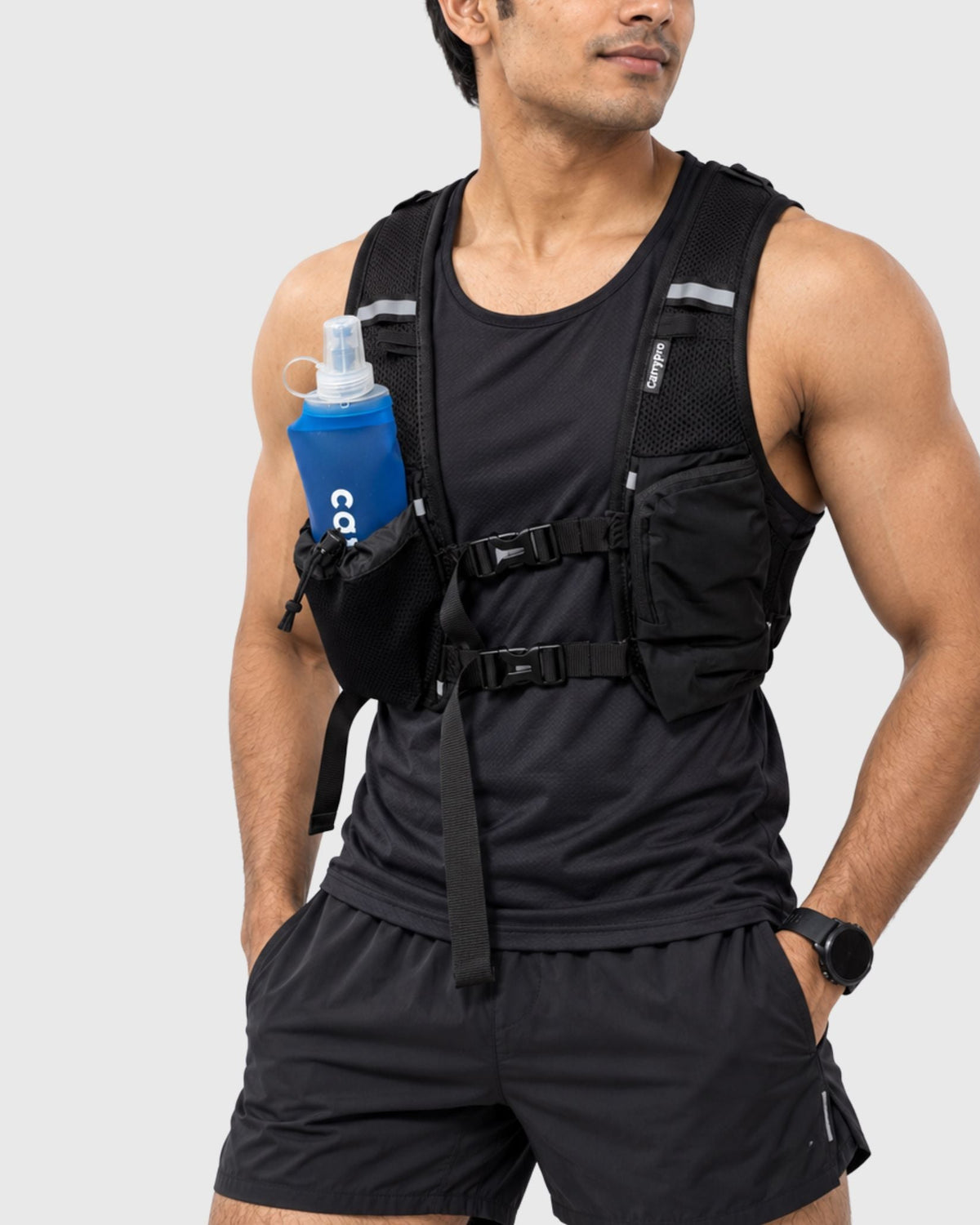



A supported road race and a self-supported trail run can cover similar distances but require different hydration setups.
On a city route with reliable water stations, carrying two accessible flasks may be enough for a runner's planned fluid intake. On a remote trail with a long gap between safe refills, a larger hydration bladder may be more practical.
Soft flasks are generally better for easy access, refilling and monitoring water intake. Hydration bladders are better suited to carrying larger volumes through a drinking tube. Neither system is automatically better for every runner.
The right choice depends on your route, refill opportunities, drinking preferences and how much fluid you need between stops.
Soft Flask vs Hydration Bladder: Key Differences
Both systems let runners carry water without holding a rigid bottle throughout the run. The biggest differences are where the water sits and how easily you can manage it.
| Feature | Soft Flask | Hydration Bladder |
|---|---|---|
| Typical capacity | 250–600ml per flask | 1–3L per reservoir |
| Position | Front vest pockets | Rear hydration compartment |
| Drinking access | Bite valve near the chest | Drinking tube routed to the shoulder |
| Refilling | Usually quicker to remove and refill | Often requires opening the rear compartment |
| Water monitoring | Easier to estimate remaining water | Harder to check without accessing the reservoir |
| Weight distribution | Water carried toward the front | Water carried against the back |
| Cleaning | Fewer components in many designs | Reservoir, tube and valve require cleaning |
| Best use case | Runs with reliable refills and accessible water needs | Longer unsupported sections requiring greater capacity |
A runner's preference may also depend on where the weight feels more comfortable. Front-mounted water and rear-mounted water create different sensations during movement.
When Should You Choose a Soft Flask for Running?
Soft flasks are particularly useful when access to water matters more than maximum carrying capacity.
1. When your route has frequent refill points
Consider a half-marathon training route around a familiar city loop.
If you know where safe drinking water is available, carrying a large reservoir may be unnecessary.
A soft flask lets you:
-
Refill without removing an entire hydration system.
-
Check approximately how much water remains.
-
Carry smaller quantities between known refill points.
-
Adjust the number of flasks according to your route.
Two 500ml flasks provide a combined nominal capacity of 1L, although you do not need to fill both completely for every outing.
2. When you want separate drinks
Some endurance runners prefer carrying plain water alongside a sports drink or carbohydrate-electrolyte mix.
Two flasks make separation straightforward.
For example, one could contain plain water and the other a drink prepared according to its manufacturer's instructions, provided the flask material and cleaning guidance permit it.
A single bladder generally holds one shared liquid supply unless you carry another container.
3. When you want to monitor water consumption
A soft flask becomes less bulky as it empties. Depending on the material and pocket design, you can often estimate the remaining volume by looking at or feeling the flask.
That makes it easier to assess whether you have enough water before the next refill point.
For runners who prefer keeping their fluids within reach, a soft flask for running is worth considering, provided it fits their vest pockets.
When Is a Hydration Bladder Better for Running?
A hydration bladder becomes useful when you need to carry more water between reliable refills.
1. When water sources are far apart
A long trail route may involve several kilometres without a dependable refill point.
In that situation, the main concern is whether you can carry the quantity of water your route requires.
A 2L bladder provides more nominal capacity than two 500ml flasks.
However, carrying capacity should not be confused with recommended consumption. Runners should plan how much fluid they actually need rather than automatically filling the largest available reservoir.
2. When you prefer drinking through a tube
A hydration bladder lets you sip through a hose routed toward your shoulder.
You do not need to retrieve a flask from its pocket or return it after drinking.
Some runners prefer this arrangement on long climbs or when moving over uneven terrain. Others find front-mounted flasks more convenient.
Neither preference guarantees better hydration or running performance.
3. When you want one water system for multiple activities
A hydration bladder can be useful across running, cycling and hiking, assuming the packs have compatible compartments and tube routing.
For example, CarryPro's 2L hydration bladder is designed for use with compatible running and trekking packs.
Its blue and grey variants have different filling and valve arrangements, so check the selected model before purchasing.
For a detailed explanation of how reservoirs and drinking tubes work, read CarryPro's existing guide on how hydration bladders work.
How Much Water Should You Carry on a Run?
There is no universal quantity that works for every 10K, half-marathon or trail run.
The appropriate amount depends on:
-
Weather: Temperature, humidity and sun exposure affect fluid loss.
-
Effort: Running intensity influences sweating and fluid requirements.
-
Individual physiology: Sweat rates differ considerably between people.
-
Route support: Available water stations and refill points determine how much must be carried.
-
Duration: Time on your feet matters alongside distance.
For example, an early-morning run on a shaded route in Bengaluru may call for a different hydration plan from a prolonged run on an exposed trail in Maharashtra.
The National Athletic Trainers' Association's position statement on fluid replacement recommends individualized hydration strategies because sweat rates and fluid requirements vary.
Excessive fluid consumption can also be dangerous, particularly during prolonged endurance exercise.
A practical way to plan your water capacity
Instead of selecting a flask or bladder based only on kilometres:
-
Identify the longest section between reliable drinking-water sources.
-
Estimate how long that section will take, accounting for terrain and elevation.
-
Use your experience from comparable runs to assess your fluid requirements.
-
Choose containers that provide enough capacity for the route.
-
Test the arrangement during training before relying on it during a race or remote outing.
Runners preparing for less familiar terrain can also use CarryPro's trail running guide for India to understand how the route affects equipment preparation.
Can You Use Soft Flasks and a Hydration Bladder Together?
Yes. Some running vests accommodate front-mounted flasks and a rear hydration reservoir.
A combined setup can be useful when a runner needs greater total capacity or wants to carry separate beverages.
For instance:
| Container | Nominal capacity | Possible purpose |
|---|---|---|
| Front flask 1 | 500ml | Accessible drinking water |
| Front flask 2 | 500ml | Additional water or a compatible sports drink |
| Rear bladder | 2L | Additional water for a long section without refills |
The combined nominal container capacity is 3L. That is not a recommendation to drink or carry 3L on every run.
Additional water increases the weight being carried. One litre of water weighs approximately one kilogram, excluding the container.
Before using multiple containers together, check that the vest has enough room for the complete setup and that its loaded fit remains comfortable.
The CarryPro Sprint Running Vest lists a dedicated rear hydration compartment and front pockets for soft flasks.
Its product specifications should be checked for compatibility with your exact containers rather than assuming every flask shape will fit.
Which Hydration System Is Easier to Maintain?
Both systems need cleaning and complete drying after use.
Soft flask maintenance
-
Empty the flask after running.
-
Wash it according to the manufacturer's instructions.
-
Clean the cap and drinking valve.
-
Allow the flask and its components to dry thoroughly before storage.
Hydration bladder maintenance
-
Empty the reservoir after use.
-
Clean the opening, interior and drinking tube.
-
Pay particular attention to the bite valve.
-
Allow the reservoir and tubing to dry completely.
-
Check the manufacturer's instructions before using cleaning agents or exposing the material to extreme temperatures.
A hydration bladder typically takes more effort to clean because it has a longer drinking tube and additional internal surfaces.
The difference may be small for occasional use but becomes more relevant when runners use and clean their equipment several times a week.
How to Choose a Hydration Setup for Your Running Routine
The decision becomes easier when you start with the route rather than the equipment.
Choose soft flasks when:
-
Your route has reliable refill opportunities.
-
You prefer accessible front-mounted water.
-
You want to monitor remaining fluid easily.
-
You intend to carry different drinks separately.
Choose a hydration bladder when:
-
Your route requires greater water-carrying capacity.
-
You prefer sipping through a drinking tube.
-
You want a reservoir compatible with different outdoor activities.
-
Your pack has a suitable rear hydration compartment.
Consider both when:
-
You have a long unsupported section and sufficient carrying capacity.
-
You want additional water alongside a separate sports drink.
-
Your vest accommodates the containers comfortably when fully loaded.
CarryPro's running collection includes hydration accessories and running packs for different carrying preferences.
The final choice should reflect how you run, where you refill and how the equipment feels with water inside it.
Frequently Asked Questions
Is a soft flask better than a hydration bladder for trail running?
A soft flask is convenient for accessible drinking and quick refills. A bladder generally provides greater water capacity. Choose according to the terrain, refill opportunities and your individual fluid requirements.
Is a 500ml soft flask enough for running?
It may be sufficient for some short or supported runs, but 500ml is not a universal recommendation. Duration, weather, exertion, individual sweat rate and access to safe drinking water all matter.
Do hydration bladders cause more bouncing than soft flasks?
Neither system automatically prevents bouncing. A full reservoir or flask can shift if it is poorly secured. Check the fit of the vest, the positioning of the containers and how the loaded equipment behaves while running.
Can I use electrolytes in a soft flask?
Many soft flasks can carry compatible sports drinks, but follow the manufacturer's material and cleaning instructions. Clean the flask thoroughly after using sugary or flavoured drinks.
Are hydration bladders or soft flasks better for marathons?
Supported marathon routes with frequent water stations may favour smaller containers. Runners who prefer carrying more of their own fluids may choose a bladder. Check race rules, aid-station availability and your tested hydration plan before deciding.