


Carrying your phone on a run comes down to three choices: a belt, an armband, or a vest. Each keeps your hands free, but each suits a different kind of run. Pick wrong and you get bounce, chafe, or a bag that holds nothing you need.
The good news is that the decision is simple once you know the one question that settles it. How far do you run, and what do you need to bring? That single answer points you to the right option almost every time.
Running belt vs armband vs vest: the quick comparison
A running belt is a waist pouch for a phone and small essentials. An armband straps a phone to your upper arm. A running vest is a chest-and-back harness built to carry water, fuel, and a layer. Belt for everyday runs, armband for phone-only short runs, vest for long distances.
Here is how the three options stack up on the things that actually matter on a run.
|
Feature |
Armband |
Running belt |
Running vest |
|
Best for |
Short runs, phone only |
Everyday runs, small load |
Long runs, hydration |
|
Carries |
Phone |
Phone, keys, cards, gels |
Water, fuel, layer, phone |
|
Bounce |
Slides with sweat |
Low, once cinched |
Lowest, weight is spread |
|
Phone access |
On your arm |
At your waist |
On your chest |
|
Best run length |
Under 30 minutes |
30 to 90 minutes |
Over 60 minutes |
Once distances grow, the load grows with them, which is why the vest sits at one end and the armband at the other. The running collection covers all three carry styles so you can match the gear to the run.
When is an armband the right choice?
An armband is the right choice only when a phone is the single thing you carry, and only on short runs. An armband keeps the screen visible for music or a fitness app. Beyond that, it does little.
Armbands were once the default, but larger phones and better alternatives have pushed them to a narrow use case.
What an armband does well
-
Keeps a phone visible for quick glances at pace or distance
-
Costs the least of the three options
-
Works for treadmill runs and short outdoor loops
Where an armband falls short
An armband slides down your arm as you sweat, and it holds nothing beyond a phone. The one-sided weight can nudge your arm swing on longer runs. For anything past a short jog, a belt or vest is more comfortable.
When is a running belt the right choice?
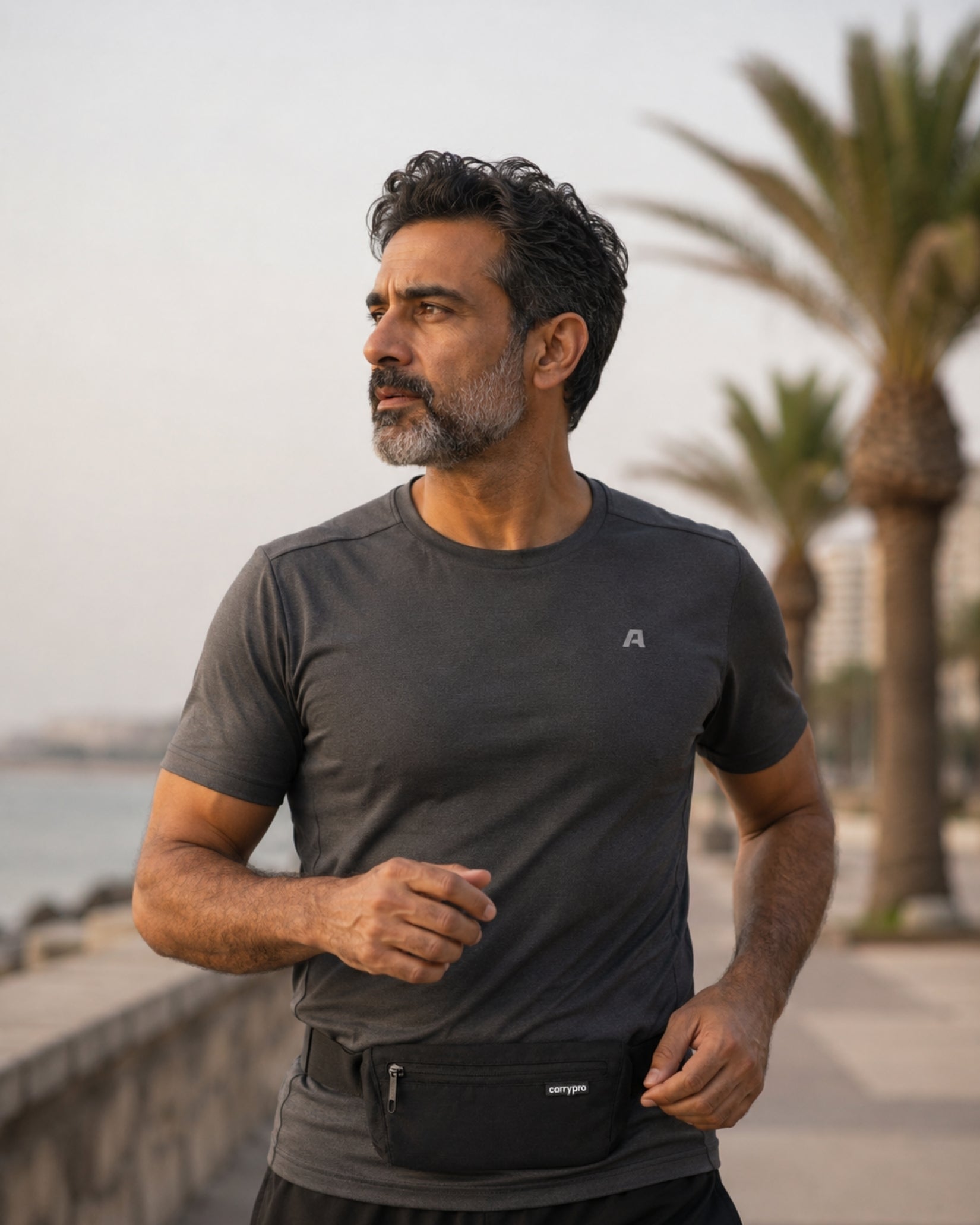
A running belt is the right choice for everyday runs where you carry a phone, keys, and maybe a gel. A belt sits flat at your waist, holds more than an armband, and stays put once adjusted. For most runners, most days, a belt is the answer.
The belt is the workhorse of the three, since it covers the widest range of runs without getting in the way.
What a running belt does well
-
Holds a phone, keys, cards, cash, and a couple of gels
-
Sits flat and low, with minimal bounce once cinched snug
-
Works for runs, walks, gym sessions, and travel days
A running belt is the simplest upgrade from stuffing your pockets, and it doubles as a secure way to carry a passport and phone when you travel.
Where a running belt falls short
A belt cannot carry water in any real volume, and loading it with too much can affect your stride. Once your runs need a bottle of water and a layer, a belt runs out of room.
When is a running vest the right choice?
A running vest is the right choice for long runs and trail runs that need water, fuel, and a layer. A vest spreads weight across your chest and back so nothing swings, even fully loaded. Long distance is where a vest earns its place.
The vest solves the problem the other two cannot: carrying real water without bounce.
What a running vest does well
-
Carries soft flasks on the front for sips without breaking stride
-
Takes a 2L hydration bladder in the back for hot, long runs
-
Distributes weight evenly, so a full load stays stable
A running hydration vest is the setup once your long runs pass an hour, and it doubles as a light day-hike pack. For fast trail days with more gear, a trail hiking backpack is the next step up.
Where a running vest falls short
A vest is more than you need for a short run, and it costs more than a belt or armband. For a quick 5k, a vest is overkill.
Stop fighting your gear and just run
The right carry disappears the moment you start moving, and the wrong one nags you the whole way. Match the option to your distance, set it up snug, and give yourself runs where the only thing on your mind is the road ahead. Try the setup on your next run and feel the difference for yourself.
Frequently Asked Questions
Is a running belt better than an armband?
For most runners, yes. A running belt holds more, sits more comfortably, and does not slide the way an armband does when you sweat. An armband still works if a phone is the only thing you carry on a short run.
Do I need a running vest for regular runs?
No. A vest is built for long runs and trail runs that need water, fuel, and a layer. For everyday runs under an hour, a belt carries everything you need with less bulk.
What is the best way to carry a phone while running?
A running belt is the most stable option for everyday runs, holding the phone flat at your waist. For long runs, a vest with a chest pocket keeps the phone secure and within easy reach.
Can a running belt carry water?
Only a small amount. Some belts add a small flask, but they are not built for real hydration. For water on long runs, a vest with soft flasks or a bladder is the better choice.
Which is better for long-distance running, a belt or a vest?
A vest is better for long distance because it carries water, fuel, and a layer with even weight distribution. A belt is fine up to about 90 minutes, but a vest takes over once you need more water than a belt can hold.
Do running vests bounce?
A well-fitted vest does not bounce, because the load sits close to your body and spreads across your chest and back. Adjust the chest and side straps snug, and the vest stays stable even fully loaded.