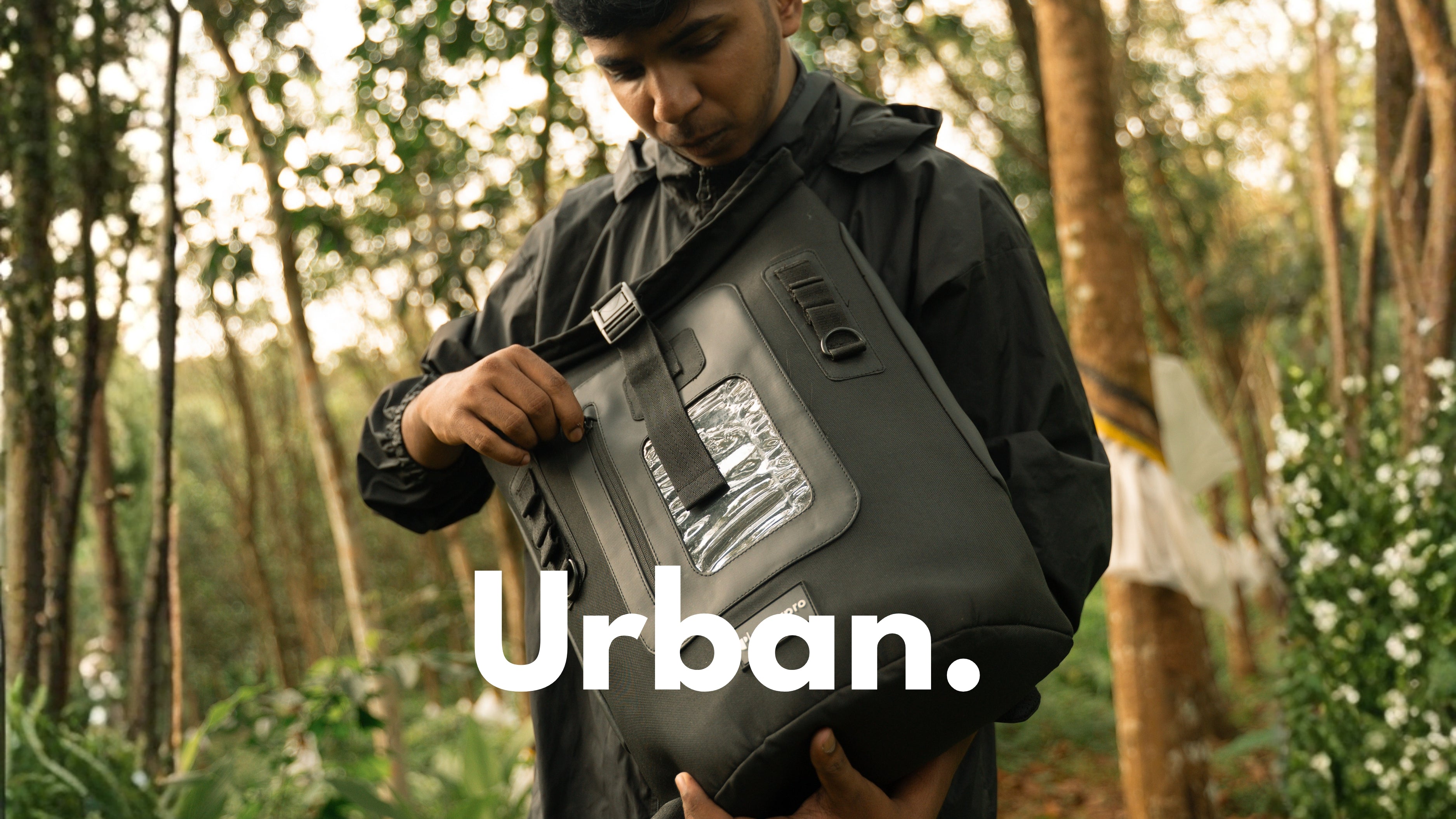


IndiGo's cabin baggage limit is a bag of up to 55 × 35 × 25 cm. Multiply that out and the box itself holds about 48 litres. Your bag has fabric, padding, a back panel and straps taking up part of that box, so a fully packed bag that fits it holds less than 48 litres of your stuff.
Now look at how many backpacks sold as cabin-friendly claim 45, 50 or more litres. Some are counting pockets. Some are counting the space you only get when you unroll or unzip an expansion. Some are quoting a number nobody measured the same way as anyone else's.
Litre ratings aren't useless. They're just less standard than they look. Here's what the number actually means and how to read it.
How is backpack capacity measured?
The recognised method is ASTM F2153, a standard test for backpack capacity. It fills every enclosed compartment with small plastic balls, measures their volume, and records two figures: unextended capacity (the bag closed normally) and extended capacity (with any extension collar or expansion opened). It deliberately leaves out open spaces like mesh pockets and bottle holders.
What the standard sets out (ASTM F2153):
-
Two numbers, not one: an unextended capacity and an extended capacity, so buyers can compare bags on the same basis.
-
Enclosed space only. Areas not fully enclosed by fabric, such as mesh pockets, water bottle holders and open compression pockets, aren't counted.
-
A lower limit. The method isn't practical for bags under 4 litres, which is why tiny slings and pouches often skip a litre rating.
-
A comparison tool. ASTM describes it as a way for manufacturers and consumers to have a consistent basis for comparing pack volumes.
Standards catalogue summaries of F2153 describe the fill as standardised 20 mm plastic balls, measured with extensions opened and then closed. The catch is that it's a voluntary method. Nothing obliges a brand to use it, and few listings say which method sits behind their number.
Why do two 40L backpacks hold different amounts?
Because "40L" can be built in different ways. One brand counts only the main compartment, another adds every pocket, and a third quotes the expanded size. Shape matters too: a tall, narrow bag and a boxy, suitcase-style one can share a number and pack completely differently.
|
How the litre number is built |
What's counted |
What it means for you |
|
Fill test, main compartment only |
The biggest enclosed space |
Conservative. The bag usually feels bigger than its rating. |
|
Fill test, all enclosed pockets (the ASTM approach) |
Every enclosed pocket added in |
Comparable across brands that use it, but pockets rarely pack as neatly as the main compartment. |
|
Extended size quoted as "the" capacity |
Expansion zip or roll-top opened fully |
You only get the headline number when the bag is expanded, and possibly over cabin size. |
|
Outer dimensions multiplied (L × W × H) |
The external box, including padding and fabric |
Overstates usable space. Treat it as a ceiling, not a capacity. |
|
No method stated |
Unknown |
Compare by outer dimensions and real packing photos instead. |
Beyond the counting method, three design choices change how much a bag feels like it holds:
-
Opening style. A clamshell bag that opens flat like a suitcase lets you pack corners and edges fully. A top-loader leaves dead space at the bottom that you can't reach neatly.
-
Internal structure. Padded laptop sleeves, frames and organiser panels take up volume inside the counted space, so a heavily organised 40L bag holds fewer clothes than a simple 40L sack.
-
Shape. Rectangular cross-sections pack efficiently. Rounded, tapered bodies look sleek but lose volume at the edges.
What do ranges like "25–30L" or "65L+" mean?
A range or a plus sign usually tells you the bag has two sizes: its everyday capacity and a larger one when an expansion is opened. That's the same split ASTM makes between unextended and extended capacity. It's more honest than quoting only the bigger number.
Our own bags use this convention:
-
The HOBO25 V3.0 is listed as 25–30L. It sits at about 25L with the roll-top rolled down and reaches about 30L when the top is unrolled fully.
-
The NOMAD 65L+ uses a plus sign for the same reason: extra room beyond the base rating.
When you see a range, plan your trips around the lower number. The upper number is for the day you're bringing back more than you took.
Can a high-litre backpack fit Indian cabin limits?
Only if it's packed below its own full size. IndiGo's 55 × 35 × 25 cm limit works out to about 48 litres of box, and the airline also caps the three sides at 115 cm combined, including handles. A backpack rated above that can only pass the sizer if it isn't filled to capacity.
Practical rules for Indian flyers:
-
Check outer dimensions first, capacity second. Airlines measure the outside of your bag, not the litres on the tag.
-
Compress an expandable bag before the gate. Roll the top down or zip the expansion shut.
-
Remember the weight limit. IndiGo's cabin allowance is 7 kg, so a large bag packed full of clothes and a laptop can hit the weight limit before it hits the size limit.
-
Weigh at home. A luggage scale costs less than one excess-baggage charge.
Every bag in our 40L travel backpacks range is designed to fit airline cabin size limits.
How can you check a litre claim before you buy?
Do three quick things: find the outer dimensions, see whether the listing says what's counted, and look for real packed photos. On delivery, run your own standard pack test. That tells you more than any rating.
Before buying:
-
Multiply the outer dimensions. Length × width × depth in cm, divided by 1,000, gives the box volume in litres. The real capacity has to be lower. If a listing claims more litres than its own box, one of the numbers is wrong.
-
Look for a range or "extended" wording. A single big number on an expandable bag is usually the expanded size.
-
Check what's counted. If mesh bottle pockets are part of the rating, the number is inflated by space you can't really pack.
-
Compare listings. Dimensions for the same bag sometimes differ across marketplaces. Trust the brand's own site and ask if they don't match.
On delivery, the standard kit test:
-
Put together a fixed test kit you'll always use, for example your laptop, a charger, three shirts, one pair of trousers and a toiletry pouch.
-
Pack it into the new bag the way you'd really travel.
-
Note how much room is left and whether it closes without strain.
-
Compare against your old bag with the same kit.
After two or three bags, you'll know exactly what "30L" and "40L" mean for how you pack, which is the only calibration that matters.
[CARRYPRO DATA: our in-house fill-test results, main compartment only vs all enclosed pockets, unextended and extended, for HOBO40 v2.0, Overnighter 30L, HOBO25 V3.0 and NOMAD 65L+, with the fill material and method stated]
Read a litre rating as a range, not a promise
When you compare backpacks, treat each litre number as a rough band and let the outer dimensions and your own kit test decide. If you already know how you pack, our guide to what 15L, 20L, 25L and 40L actually look like packed shows the practical difference. For two- or three-day trips, start with our 30L weekend backpacks and size up only if your kit test says so.
Frequently asked questions
How many litres of backpack fit in cabin baggage on Indian flights?
IndiGo's limit of 55 × 35 × 25 cm is about 48 litres of external box, so a fully packed bag that fits holds somewhat less than that once fabric and padding are accounted for. Always check your airline's current dimensions and weight limit.
Do side pockets count towards a backpack's litres?
It depends on the brand. The ASTM F2153 method counts enclosed pockets but excludes open spaces like mesh pockets and bottle holders. Not every brand follows it: some count only the main compartment, others add every pocket, open ones included. If the listing doesn't say, assume pockets may be included.
What does the plus in "65L+" mean?
It usually means the bag can expand beyond its base capacity, through an extension collar, roll-top or expansion zip. Plan around the base number for daily packing and treat the extra as overflow space, remembering that an expanded bag may exceed cabin dimensions.
How do you convert backpack litres to cubic inches?
One litre is about 61 cubic inches, so a 40L backpack is roughly 2,440 cubic inches. This helps when comparing Indian listings with international brands that still quote cubic inches.
Is a higher-litre backpack always better for travel?
No. A bigger bag weighs more empty, tempts you to overpack, and may not fit cabin limits when full. For most trips of a week or less with laundry access, a well-organised 30–40L bag is easier to carry and keeps you out of the check-in queue.
Sources
-
ASTM F2153-07(2018), standard test method for measurement of backpack capacity: unextended and extended capacity, exclusions and scope
-
iTeh Standards: ASTM F2153-07(2018) summary: fill material and procedure
-
IndiGo: cabin baggage: cabin bag dimensions, 115 cm linear limit and 7 kg allowance