
Most camera bags are designed around one job: protect the camera. They do it well, with padded dividers, quick-access side panels, and customizable cube inserts. But the moment a laptop enters the equation; the design falls apart. The laptop either shares space with the camera gear (bad for both), sits in a sleeve that's an afterthought (too thin, too loose), or doesn't fit at all.
Photographers who shoot and edit in the same session need a bag that treats both the camera and the laptop as primary passengers. Not one protected and the other tolerated. This guide covers what to look for in a camera bag that handles both, how the internal layout should work, and when a dedicated camera bag makes more sense than a regular travel backpack with a camera insert.
Why Can't a Regular Backpack with a Camera Insert Do This Job?
It can, partially. A camera cube dropped into a standard everyday backpack protects the camera body and lenses. But the backpack wasn't designed around the cube's dimensions. The remaining space is oddly shaped, the laptop compartment wasn't sized to coexist with a cube, and the bag's access points don't align with how photographers reach for gear.
What a purpose-built camera laptop bag adds
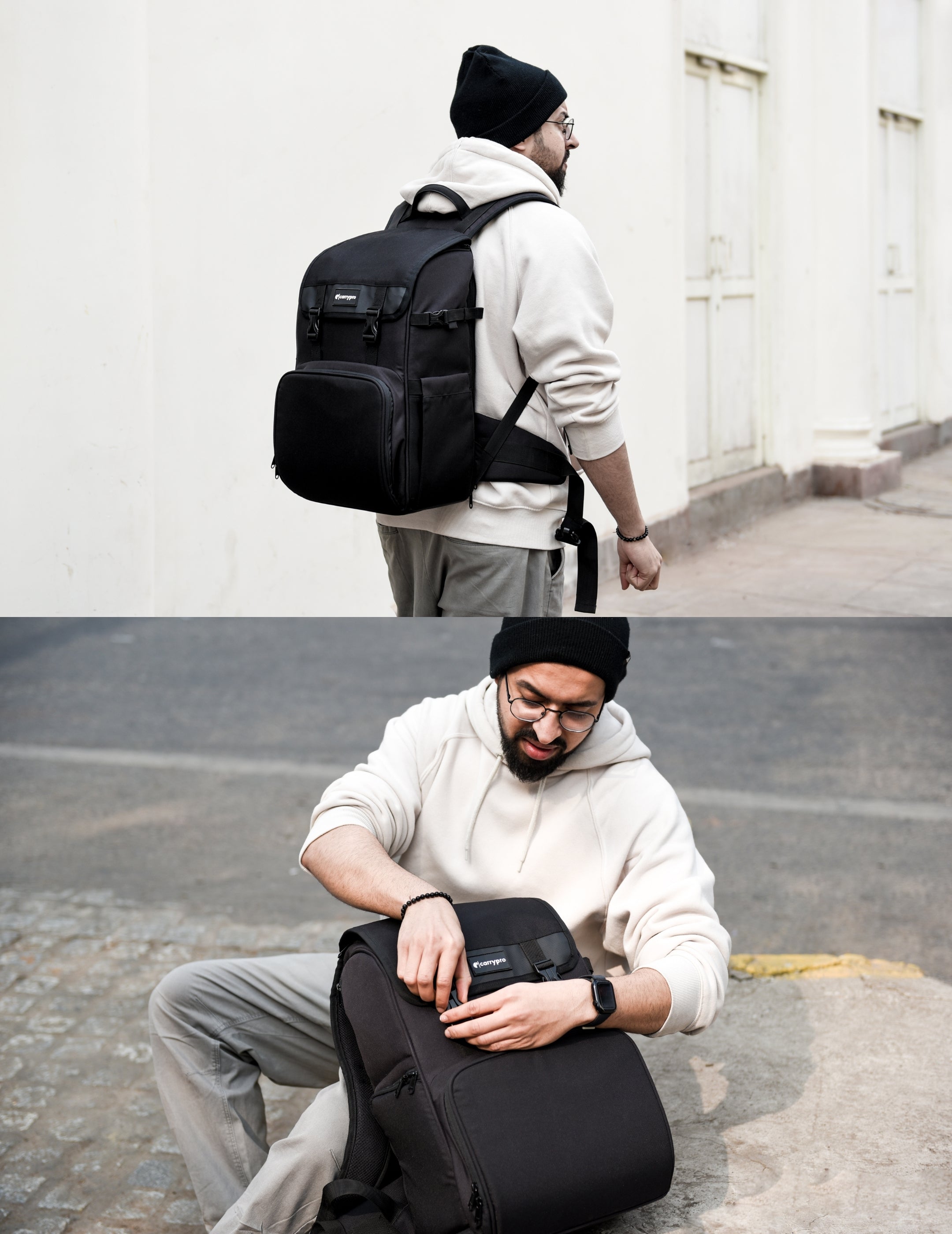
A dedicated camera section with padded dividers that fit the bag's internal shape exactly. A separate laptop compartment behind the back panel, completely isolated from the camera section. Access points designed for camera retrieval (side zip, back panel, or quick flip) that don't require opening the laptop section. Weight distribution that accounts for the combined load of camera gear (1 to 3 kg) plus a laptop (1.5 to 2.5 kg) plus personal item.
What Features Matter in a Camera Bag with a Laptop Compartment? Carry your gear properly
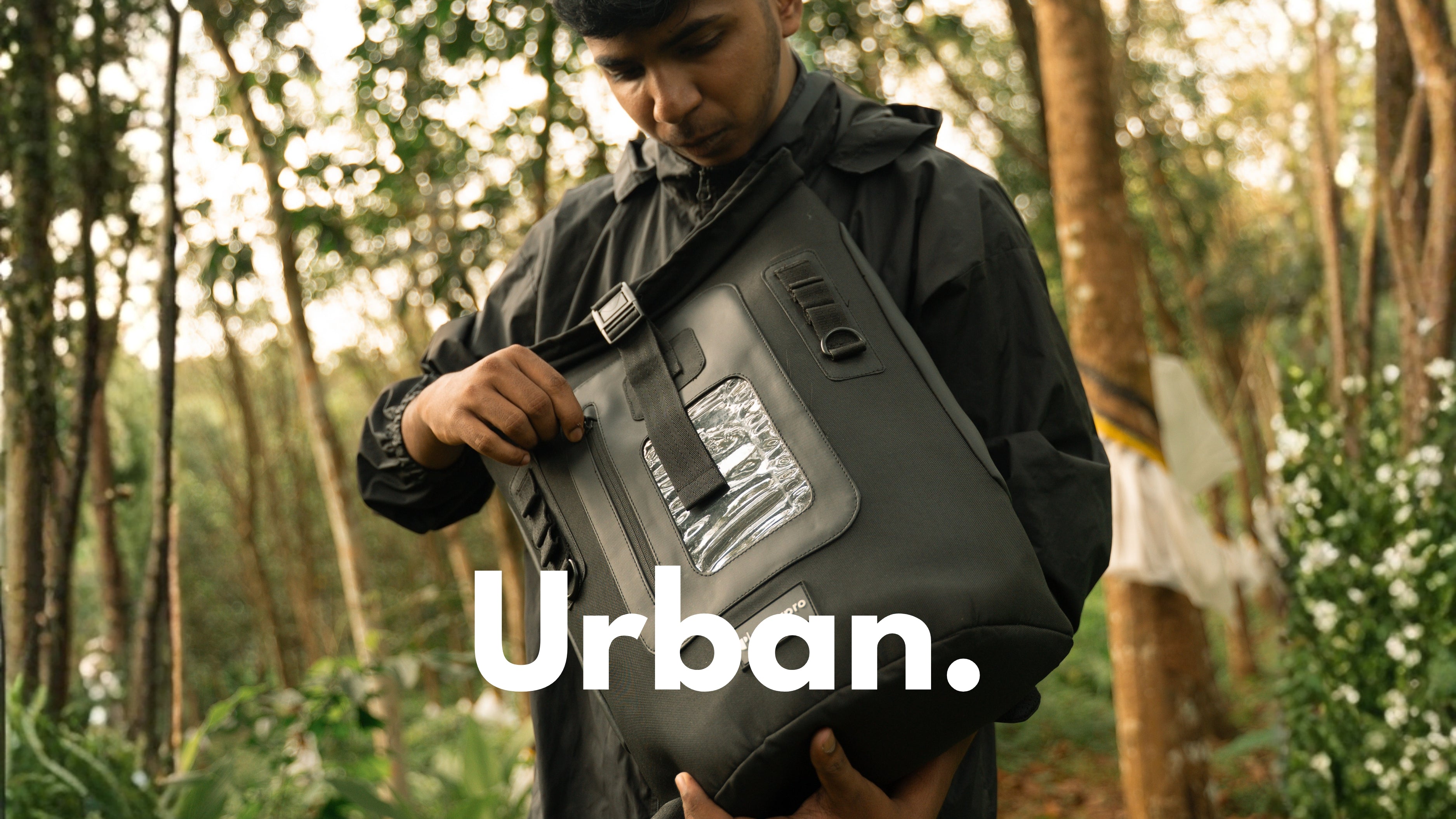
Browse our full range of camera backpacks, including rolltop camera backpacks for variable loads, photographer-specific backpacks with deeper lens compartments, and camera sling bags for grab-and-go shoots.
Physically separated camera and laptop zones
The camera and laptop should never share a compartment. The camera section needs rigid, padded dividers to prevent lens-on-body contact. The laptop section needs a soft, padded sleeve to prevent screen pressure. Combining them means either the dividers press against the laptop screen or the laptop slides against the camera body during movement. Neither is acceptable.
Side or back-panel camera access
Top-loading camera bags require pulling the camera up through the main compartment, past the laptop, past any clothes or personal items. This is slow, risky for the laptop, and impractical during a shoot. Side-access (a zip on the side of the bag that opens directly into the camera section) or back-panel access (a zip on the spine-facing panel) lets the photographer reach the camera without disturbing the rest of the bag.
Customisable dividers
Every photographer's kit is different. One body plus two lenses. One body plus one lens plus a drone. One body plus a flash plus batteries and memory cards. Fixed compartments force gear into shapes that don't match. Removable, repositionable velcro dividers let the photographer rebuild the interior around their specific kit.
Laptop compartment size
The laptop compartment should fit the photographer's actual laptop, not just any laptop. A 13-inch MacBook Air and a 15.6-inch Dell Inspiron have very different chassis dimensions. The compartment needs enough padding to protect the screen and enough structure to keep the laptop from sliding during walks and transit.
Comfortable carry at combined weight
A camera body (500 to 800g), one or two lenses (300 to 700g each), a laptop (1.5 to 2.5 kg), chargers, batteries, and personal items easily add up to 6 to 8 kg. At this weight, padded shoulder straps, a breathable back panel, and a sternum strap are the minimum. A waist belt helps on longer walking days.
What's the Ideal Internal Layout?
Bottom section: camera gear
The camera body and lenses sit in the lower section of the bag, surrounded by padded dividers. This is the densest, heaviest section and placing it low keeps the bag's centre of gravity stable. Side-access zippers open directly into this zone for quick retrieval without setting the bag down.
Middle section: personal items
Clothes (if travelling), a rain jacket, snacks, a water bottle. These sit above the camera gear and below the laptop. This section is the most variable and changes based on whether the bag is being used for a day shoot or a multi-day trip.
Back panel: laptop
The laptop sits in its own padded sleeve against the back panel, accessible through an independent zip (usually from the top or the side). It never touches the camera section. It never shares space with personal items. It sits closest to the back, where the padding is thickest and the weight distribution is optimal.
Camera Bag vs Camera Insert: When Does Each Make Sense?
Dedicated camera bag
Best when photography is the primary activity. The bag is designed around the camera, with every access point, pocket, and strap optimised for shooting. Use this for dedicated photo walks, client shoots, events, and any day where the camera comes out more than 5 times.
Camera insert in a regular backpack
Best when photography is secondary. Travelling, commuting, or hiking with a camera as a companion, not the main event. Drop the cube into any backpack, shoot when the moment arises, and use the rest of the bag for non-camera items. Use this for travel days, casual sightseeing, and trips where the camera is one of many items, not the centrepiece.
The hybrid approach
Some camera backpacks use a detachable camera cube that converts the bag between modes. With the cube in, it's a camera bag. With the cube out, it's a standard travel or everyday backpack. This is the most versatile option for photographers who travel frequently and don't want to carry two bags.
How Much Should a Camera Laptop Bag Cost?
Camera bags with proper laptop compartments, padded dividers, side access, and quality construction typically range from Rs. 3,000 to Rs. 15,000 in India. Below Rs. 3,000, the padding and divider quality drops noticeably. Above Rs. 15,000, the features are often incremental (weather sealing, carbon fibre buckles) rather than fundamental.
The right investment depends on what's inside the bag. A kit worth Rs. 50,000 to Rs. 2,00,000 deserves a bag that protects it properly. Skimping on the bag to save Rs. 2,000 while carrying gear worth ten times that amount is a false economy.
Who Needs This Type of Bag?
- Travel photographers who shoot at a destination and edit at the hotel or café the same day. The camera and laptop travel together on every outing.
- Content creators who shoot photos and video, then review, edit, and upload on location. The laptop is part of the creative workflow, not just a leisure device.
- Photography students who carry a camera to class alongside a laptop for lectures and assignments. Both need protection in the same bag.
- Hybrid professionals who use a camera for client work (real estate, events, product photography) and a laptop for editing, invoicing, and communication. The camera bag is the mobile office.
Browse camera backpacks. Browse everyday backpacks. Browse accessories. Explore the full range.
Frequently Asked Questions
Can a camera bag protect a laptop as well as a dedicated laptop backpack?
Yes, if the camera bag has a separate, padded laptop compartment with independent access. The protection level is comparable. The difference is that a camera bag allocates more internal space to camera gear and less to general storage.
What laptop size fits in most camera bags?
Most camera laptop bags accommodate up to 15.6 inches (Windows) or 16 inches (MacBook). Smaller camera bags may max out at 13 or 14 inches. Always check the compartment dimensions against the laptop's chassis measurements.
Is a camera sling bag big enough for a laptop?
Generally no. Camera sling bags (8 to 12 litres) are designed for a camera body, one lens, and small accessories. A laptop requires a camera backpack with 25+ litres.
Should the camera or the laptop sit closer to the back?
The laptop. It's flatter, heavier relative to its size, and benefits most from being close to the spine for weight distribution. The camera gear sits in the lower section where side-access zips allow quick retrieval.